
Hands-On STEM Activities for Kids: 10 Easy Experiments
Table of Contents
- Hands-On STEM Activities for Kids: What Works and Why
- Easy STEM Activities for Kids You Can Do at Home
- Farm STEM Activities for Kids: Learning From Working Animals
- STEM Activities for Preschoolers: Fizz, Goo, and Discovery
- Hands-On Science Experiments for Kids: Engineering Challenges
- Materials, Setup Time, and Learning Objectives
- Extending STEM Learning: Subscription Boxes and Farm Programs
- Conclusion
- Frequently Asked Questions
Last Updated: October 5, 2026
Hands-On STEM Activities for Kids: What Works and Why
Hands-on STEM activities for kids transform abstract concepts into tangible learning. At Donkey River Farm, we design science-based programs tied to farm life and animal science.
The challenge isn't finding activities, it's finding ones that work. Many sound educational but feel forced or demand hours of setup for ten minutes of engagement. The activities here share three traits: genuine learning, easy-to-find materials, and visible, immediate results.
Below are ten hands-on STEM activities organized by age group and learning style, each with materials, setup time, and the core science concept. Whether you're a parent, teacher, or homeschool family, these work in real homes and classrooms.
Easy STEM Activities for Kids You Can Do at Home
These activities use materials most families already have, with quick setup and dramatic results.
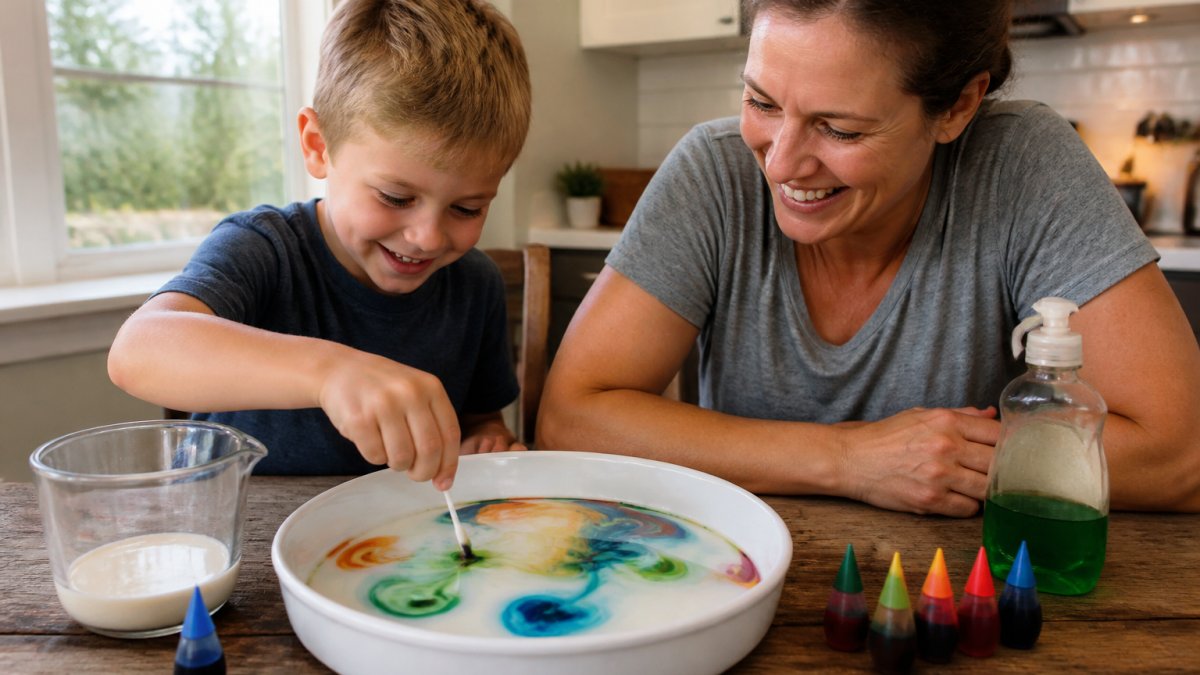
1. Milk Fireworks and Curds: Chemistry in Action
Milk contains a protein called casein that reacts dramatically to dish soap. Add food coloring and soap, and the casein molecules rush away, creating swirling patterns like fireworks.
Materials: Whole milk, food coloring, dish soap, shallow dish, cotton swabs Setup Time: 5 minutes Learning Objective: Surface tension, chemical reactions, protein behavior
Pour milk into a shallow dish, add food coloring, dip a cotton swab in dish soap, and touch it to the milk. The soap breaks surface tension, causing colors to explode outward.
This teaches why soap cleans while delivering a repeatable spectacle kids can vary with different soap amounts and colors.
2. DNA Extraction from Strawberries
This hands-on STEM activity shows kids that DNA is a physical molecule they can see, using kitchen chemistry to precipitate it out of solution.
Materials: Strawberries, dish soap, salt, cold water, rubbing alcohol, jar, coffee filter Setup Time: 10 minutes Learning Objective: Cell structure, DNA extraction, molecular precipitation
Mash a strawberry in a jar. Mix one part dish soap, one part salt, and four parts cold water; pour over the strawberry, stir, and let sit five minutes.
Kids can hold the jar to the light and see the genetic material that makes strawberries unique, connecting abstract biology to something tangible.
3. Rain Cloud in a Jar
This experiment demonstrates how water condenses in the atmosphere to form clouds, simple enough for preschoolers but teaching real meteorology.
Materials: Jar with lid, hot water, ice, food coloring (optional) Setup Time: 2 minutes Learning Objective: Water cycle, condensation, atmospheric pressure
Pour hot water into a jar until one-third full, place ice on top, and seal. Steam rises and condenses on the cold surface, forming a visible cloud. Add food coloring before sealing for a colored cloud.
It's fast enough to repeat, and kids see the water cycle happen in real time.
4. Walking Rainbow Experiment
This hands-on STEM activity demonstrates capillary action and color mixing using only paper towels and food coloring.
Materials: Paper towels, food coloring, water, cups or bowls Setup Time: 5 minutes Learning Objective: Capillary action, color mixing, water absorption
Fold paper towels lengthwise and drape them across cups of colored water. The paper absorbs water and carries color to neighboring cups, blending where colors meet. Set it up at night and check in the morning for the full rainbow.
It needs almost no supervision and teaches how plants absorb water through roots, while color mixing introduces primary and secondary colors.
Farm STEM Activities for Kids: Learning From Working Animals
Farm environments offer learning opportunities classrooms cannot replicate. Observing Highland cows, donkeys, and goats, children see genetics, adaptation, and ecology in action.
At Donkey River Farm, we integrate animal observation into our STEM programs because animals engage children's curiosity in ways worksheets cannot. A child watching a cow's digestion or a donkey's problem-solving learns applied biology that sticks.
Farm-based STEM activities work best structured around real animal care, observation, and measurement. Children can measure weights, track eating patterns, and observe herd behavior, turning the farm into a living laboratory.
STEM Activities for Preschoolers: Fizz, Goo, and Discovery
Preschoolers learn through sensory exploration and immediate cause-and-effect. These activities emphasize the "wow" factor while building foundational science vocabulary.
5. Magic Mud and Sensory Play
Also called oobleck, this non-Newtonian fluid acts as liquid or solid depending on the force applied. Preschoolers love the tactile experience, and the science is genuine.
Materials: Cornstarch, water, food coloring, bowl Setup Time: 5 minutes Learning Objective: Non-Newtonian fluids, states of matter, sensory exploration
Mix two parts cornstarch with one part water and food coloring if desired. It feels solid when squeezed quickly but flows like liquid when moved slowly, teaching that matter doesn't fit neat categories.
The sensory element keeps preschoolers engaged for long stretches as they discover the science through play.
6. Bubble Science and Giant Bubbles
Bubbles teach surface tension and film formation while providing obvious visual feedback. Preschoolers can blow bubbles for hours and still be learning.
Materials: Dish soap, water, sugar, corn syrup, bubble wands or pipe cleaners Setup Time: 5 minutes Learning Objective: Surface tension, film formation, air pressure
Mix one part dish soap with six parts water, adding a tablespoon of sugar or corn syrup per cup to strengthen the film and extend bubble life.
Junior Farm Scientist: Monthly Kids Science Box (Ages 6–12) →
For giant bubbles, bend pipe cleaners into large loops; the mixture holds films big enough to step through, and preschoolers build fine motor control while experimenting with size and shape.
7. Fizzy Volcano Reactions
This classic hands-on STEM activity demonstrates acid-base reactions with immediate, dramatic fizzing and color.
Materials: Baking soda, vinegar, food coloring, dish soap, container, tray Setup Time: 5 minutes Learning Objective: Acid-base reactions, chemical change, gas production
Place baking soda in a container on a tray, add food coloring and dish soap, then pour in vinegar and watch it erupt. The acid (vinegar) and base (baking soda) react to produce carbon dioxide gas, creating foam that overflows.
Preschoolers can repeat it with fresh baking soda, each eruption teaching the same chemical principle through direct observation.
Hands-On Science Experiments for Kids: Engineering Challenges
Engineering challenges move beyond observation into design and problem-solving: children plan, build, test, and refine solutions, learning the engineering design cycle while producing tangible results.
8. Egg Drop Challenge
This challenge asks: how can you protect a raw egg from breaking when dropped from a height? Students design containers from available materials.
Materials: Raw eggs, various materials (foam, bubble wrap, paper, cotton, plastic bags), tape, containers Setup Time: 20 minutes Learning Objective: Engineering design, protective structures, impact absorption
Give each child or team an egg and materials, then challenge them to build a container that protects it from increasing heights: waist, then shoulder, then a ladder or second-story window. The egg surviving the greatest height wins.
It teaches that good design requires testing and iteration, and which materials absorb impact best around a fragile object.
9. Marble Run and Gravity Exploration
Building a marble run teaches gravity, momentum, and structural design. Children experiment with angles, heights, and pathways.
Materials: PVC pipe, paper towel tubes, plastic gutters, foam tubes, marbles, tape, supports Setup Time: 30-45 minutes Learning Objective: Gravity, momentum, energy transfer, structural engineering
Provide materials and ask children to build a track guiding a marble from start to finish through turns, jumps, and obstacles, adjusting angles and heights to control speed and direction.
This hands-on STEM activity teaches cause-and-effect deeply: a small angle change dramatically affects marble behavior, so children learn through experimentation.
10. Catapult Build and Launch Experiments
Catapults teach lever mechanics, projectile motion, and design optimization, engaging for elementary through high school ages.

Materials: Popsicle sticks, rubber bands, plastic spoons, tape, foam projectiles or marshmallows Setup Time: 20-30 minutes Learning Objective: Simple machines, projectile motion, force and distance
Build a simple catapult from popsicle sticks lashed with rubber bands and a plastic spoon as the launch arm. Launch foam projectiles at targets, experimenting with rubber band tension, spoon angle, and projectile weight for distance and accuracy.
Students measure launch distance and adjust design variables to improve performance, learning the scientific method through hands-on experimentation.
Materials, Setup Time, and Learning Objectives
| Activity | Age Range | Setup Time | Key Materials | Core Concept |
|---|---|---|---|---|
| Milk Fireworks | 4+ | 5 min | Milk, soap, food coloring | Surface tension, chemical reactions |
| DNA Extraction | 8+ | 10 min | Strawberries, soap, alcohol | Cell structure, molecular science |
| Rain Cloud | 4+ | 2 min | Jar, hot water, ice | Water cycle, condensation |
| Walking Rainbow | 5+ | 5 min | Paper towels, food coloring | Capillary action, color mixing |
| Magic Mud | 3+ | 5 min | Cornstarch, water | Non-Newtonian fluids |
| Bubbles | 3+ | 5 min | Soap, water, sugar | Surface tension, film formation |
| Fizzy Volcano | 3+ | 5 min | Baking soda, vinegar | Acid-base reactions |
| Egg Drop | 8+ | 20 min | Egg, protective materials | Engineering design, impact absorption |
| Marble Run | 6+ | 30 min | Tubes, marbles, supports | Gravity, momentum, structure |
| Catapult | 7+ | 25 min | Popsicle sticks, spoon, rubber bands | Simple machines, projectile motion |
Extending STEM Learning: Subscription Boxes and Farm Programs
Hands-on STEM activities for kids work best as part of a consistent learning pattern.
The National Science Teachers Association emphasizes that hands-on learning produces stronger retention than passive instruction.
Subscription science boxes deliver curated experiments monthly, eliminating planning and material-gathering.
Our Junior Farm Scientist box delivers four to five real experiments monthly around farm science concepts.

Beyond subscription boxes, farm-based STEM programs offer advantages home experiments cannot match.
These programs combine structured science instruction with the engagement of real animals and a working farm.
Conclusion
Hands-on STEM activities for kids transform how children understand science. The ten experiments here share a common thread: immediate, visible results using simple materials, and genuine scientific principles taught through direct experience.
Whether you're running a single milk fireworks experiment at home or enrolling in a farm-based STEM program, the goal is the same: build curiosity and confidence in young learners. The best activities are the ones children want to repeat, modify, and share.
At Donkey River Farm, we've built our educational programs around this principle. Our Junior Farm Scientist and Little Farm Friends subscription boxes deliver real farm science to your kitchen table each month, while our Fall CO-OP and Nature Co-op programs connect children directly with animals and expert instruction.

Frequently Asked Questions
What are the best hands-on STEM activities for kids at different ages?
Preschoolers (ages 3-5) thrive with sensory-based activities like fizzy reactions, cloud jars, and magic mud that don't require reading. Elementary kids (ages 6-12) enjoy hands-on science experiments such as DNA extraction, milk chemistry, and engineering challenges like egg drops and catapults. Teenagers (ages 13-18) benefit from structured lab work with real data collection and formal lab reports. Matching the activity to developmental level keeps kids engaged without frustration.
How can farm STEM activities for kids teach real science concepts?
Farm environments naturally teach biology, chemistry, and ecology. Observing animal behavior demonstrates genetics and adaptation. Studying milk composition covers pH testing and protein chemistry. Growing plants teaches photosynthesis and plant biology. Farm-based STEM programs like those at Donkey River Farm connect abstract concepts to real-world systems kids can see, touch, and measure.
What household materials do you need for easy STEM activities?
Most simple STEM activities use items already in your kitchen: milk, dish soap, vinegar, baking soda, food coloring, sugar, salt, and water. Paper, tape, and cardboard work for engineering challenges. Avoid expensive equipment, the focus is on exploration and discovery. Check each activity's materials list before starting so you're not missing anything halfway through.
How do you make hands-on science experiments for kids actually engaging?
Let kids predict outcomes before experimenting, give them control over variables, and celebrate mistakes as learning. Hands-on activities work best when kids do the work themselves rather than watching a demonstration. Connect results to real life, milk fireworks show how chemistry works in food, DNA extraction explains inheritance. Keep sessions to 20-30 minutes for younger kids, 45-60 minutes for older students.